Elevator, Hold, Music, Progress?


In staying with Italo Calvino’s Six Memos for the Next Millenium, today is a jump to the fifth: multiplicity. As far as this being a newsletter goes, what follows is “news” about the situations that the use of generative AI is creating for organizations, and society writ large. The top line news is that if culture is healthy in an organization (or society), the arrival of generative AI can be managed without too much trouble. If culture is already struggling, the addition of generative AI is an accelerant of distrust, uncertainty, confusion, and loss. Maybe this is not news.
Generative AI in the Organization
Which leads to some of the work of this moment, from any organizational or societal perspective. Rather than receiving generative AI as a product that brings new data protection, security, privacy and compliance rules, making efforts to receive it in the staidest manner possible: as a change management project. With change management, we have frameworks to guide us to be intentional and thoughtful about if and how we use it. Otherwise, we leave that power to the companies that create it, and the ill-conceived conflation of adoption with managed response.
The pattern of being successful in using new technology products is to refuse their overblown promise and novelty, to sift through the practical impacts, challenges, and benefits, and to separate them from the commercial and government narratives. This means traveling on the middle road of lightness – this product is not nothing, and it’s not everything.
In many rooms these days, if you ask about the use of generative AI, you’ll get a mix of responses – people using ChatGPT from waking moments to sleep, others that see it as the anti-Christ, several that don’t care, several that enjoy it as a thought partner, and a few that are insistent on strategically reinventing their lives and operations around it. To engage with this issue, multiplicity encourages us to think about principles or approaches for use that don’t demand universal conformity. This offers us practice on doing the same in our lives more generally, a sound proposition in a time where the earth is explicitly reminding everyone who is really in charge.
At this point in history, as shared by David Suzuki, survival might be the only useful ideological organizing proposition. This means a political and organizational culture informed by the need to survive together, one that does not demand binary answers but rather engagement in constant adaptation of conditions and relationships across many kinds of difference. Nuance. And maybe a refusal to make things heavy, even if they are serious. A politics less dependent on legal mechanisms; more on norms. Listening and sensing and improvisation. All, also, features of being in tune with music. Music calls us to be more in tune with our bodies, something technocratic culture has done its best to delegitimize, erase, and remove.
Interrupting the Monotony of Mechanistic Culture
Figuring out how to tap into our shared embodied nature has endless shapes, rituals, and histories. A few years back, the Toronto Symphony Orchestra (TSO) hosted an event in partnership with Song Exploder, a podcast that deconstructs and explains famous songs. The featured piece at the TSO was The Rite of Spring, by Russian composer Igor Stravinsky.
The Rite of Spring is a pagan story; it’s a ballet about a virgin dancing herself to death to appease the gods, it’s also about the creative bursts of energy that come along with Spring. It's music that refuses comfort and monotony and looks to seasons and cycles for inspiration.
The Rite of Spring debuted in Paris, 1913 (both the music and the accompanying ballet) and caused a significant ruckus. The piece is an interesting listen, and not an easy one. Per Wikipedia: “Stravinsky's score contains many novel features for its time, including experiments in tonality, metre, rhythm, stress, and dissonance.” It sounds like both a horror movie and institutional rebellion.
The Rite of Spring came to mind last month when I walked into a music set by Sanjeet Takhar, pictured below.
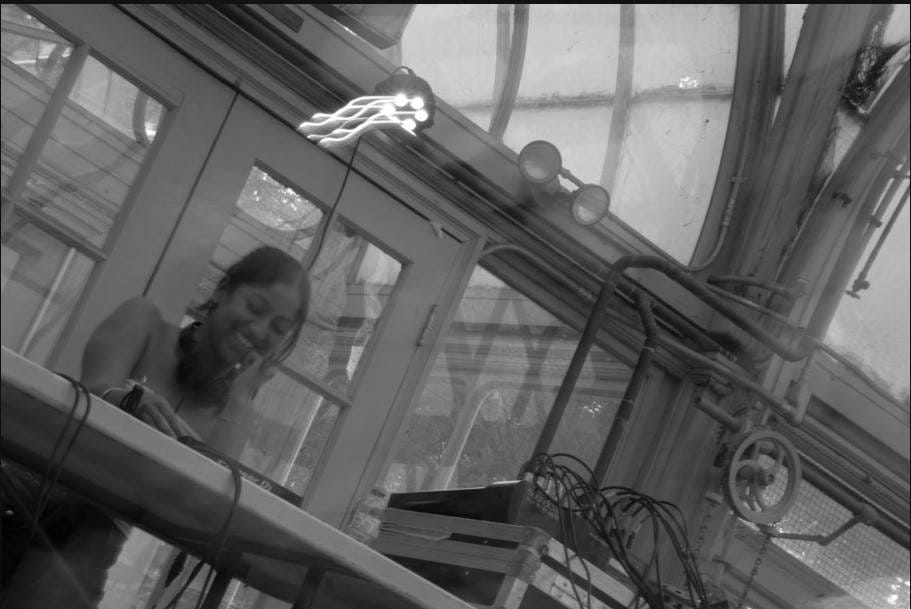
Photo credit: Hasan Naqvi for Toronto Climate Week. Taken at FERAL?! by UKAI Projects
It was electronic music, but nothing I could quickly slot into a category. This made sense, given that our hosts, UKAI Projects, had set up the night for all of us to get feral together, to think about what myths and feral-ness offer as ways to respond to climate collapse and technology. Sanjeet and I spoke later that evening, roving topically from noise music to free jazz to politics and culture. She has since shared the following related quote with me from a book titled ‘A Power Stronger Than Itself - The AACM and American Experimental Music’ by George E. Lewis:
"The esthetics of jazz demand that a musician play with complete originality, with an assertion of his own musical individuality.... At the same time jazz requires that musicians be able to merge their unique voices in the totalizing, collective improvisations of polyphony and heterophony.
The implications of this esthetic are profound and more than vaguely threatening, for no political system has yet been devised with social principles which reward maximal individualism within the framework of spontaneous egalitarian interaction.” - John Szwed
Some of the most impressive communication between musicians that improvise together is non-verbal, the knowing and sensing when to come in with a solo, how long to go, intent listening, knowing how to play it back into the whole. The configurations of how we exist together in musical groupings – jazz ensemble, symphony, producer – model the work of existing together as a different politics, and requires much more bodily presence than abstracted information processing allows us.
Critical about this quote, and multiplicity, and dominant culture – to be great is not a solo or a group effort. It’s both. Not the individual or the collective, but both, and both in strong force. You need to be great yourself to help the collective be great. There is something of a confusion in many collective political spaces that to be in solidarity means to subsume yourself into the collective. This may be part of a desire to refuse neoliberal individuality, to think all individual accomplishment is inherently marred because it is a solo act.
The flip is also common, people that are strong individually and a nightmare to collaborate with. Many of us are familiar with both dynamics. The challenge here is to understand and be both excellent at how you exist in the world as an individual *and* take just as much care in how you do that with others. What does that look like, and how do we create conditions for it, in workplaces, in society? In democracy?
Matt Pearce recently shared a compelling piece of writing about this tension that exists within freedom and democracy in his recent post titled What if People Just Prefer Bowling Alone? It points at the uncomfortable truth that many collective activities, as currently imagined and practiced, push people away from each other because they’re simply unpleasant or demand too much deference to the group.
Generative AI as Language as Elevator Music, Hold Music, Something to Interrupt?
In thinking of analogy, first I wondered if generative AI was elevator music. Which led me to read about the history of elevator music. Elevator music was created to distract passengers from their fear of tall buildings and the noisy sounds of the elevator machinery. There may be something here, about the comforting and banal language of the chatbot, and also the way in which this inoffensive sound is in fact covering up a bigger noisier machine that is doing much more harm in the background. But it’s imperfect. Then it seemed hold music might be more the right comparative – all this text being generated and people seeming to be busy when in fact nothing is changing. Just holding. Looks like progress but upon closer inspection, no, no forward motion.
In any case, it has been fruitful to push into thinking in the direction of sound and noise and music when words are seeming more cluttery than ever and our bodies seem to be more important to right action. I’m enjoying the ways that people are increasingly confident in vocalizing what they don’t like about more computers everywhere all the time, and moving through these conversations in workplaces is a confirming experience that we can always figure things out if we want to, if leaders make time and space for it. Yes, so long as we live in a militarized world, many of these technologies are indeed inevitable. But good leadership knows and will refuse that if and how we use them are inevitable - for this is part is not inevitable in the least.
The general pushback on the idea that generative AI being created as a product is somehow inherently progress (rather than simply a new product on the market) looks like political inspiration. The effort now is to continue the practice of multiplicity, of designing responsive alternatives for how we co-exist, and sitting with the noise and discomfort and time and money investment that this effort requires.